Drawing the line
Drawing the line
Olaf Gulbransson, Ragnvald Blix and the dilemmas of the satirical cartoon
English exhibition text
If a picture is worth a thousand words, perhaps a satirical cartoon is worth ten thousand. Intersecting art with journalism, the satirical cartoon is a catalyst for debate, creating space for new perspectives and standing loudly up to power. Throughout the history of democracy, satire has been an active component – like an unruly watchdog.
Today, however, the position held by the satirical cartoon is rather uncertain. Editorial teams are making staff cuts, and illustrators are not their priority. Alongside this, AI offers its services without asking anything in return. Worldwide, satire is facing political pressure through censorship, control and restrictions on freedom of speech. Laughter can be a powerful weapon: it can undermine authoritarian forces in subtler ways than words.
But this is nothing new. Satire has survived encounters with totalitarian regimes, crises and world wars – and emerged standing. In this exhibition, we embark on a journey with Norway’s most prominent cartoonists, Olaf Gulbransson and Ragnvald Blix, through the dramatic years from 1900 to 1945. Their art provides a way to perceive our current times and the recurring challenges faced by satire.
Olaf Gulbransson
(Born in Christiania, now Oslo, in 1873. Died in 1958.)
Refined cartoonist and feral child of nature.
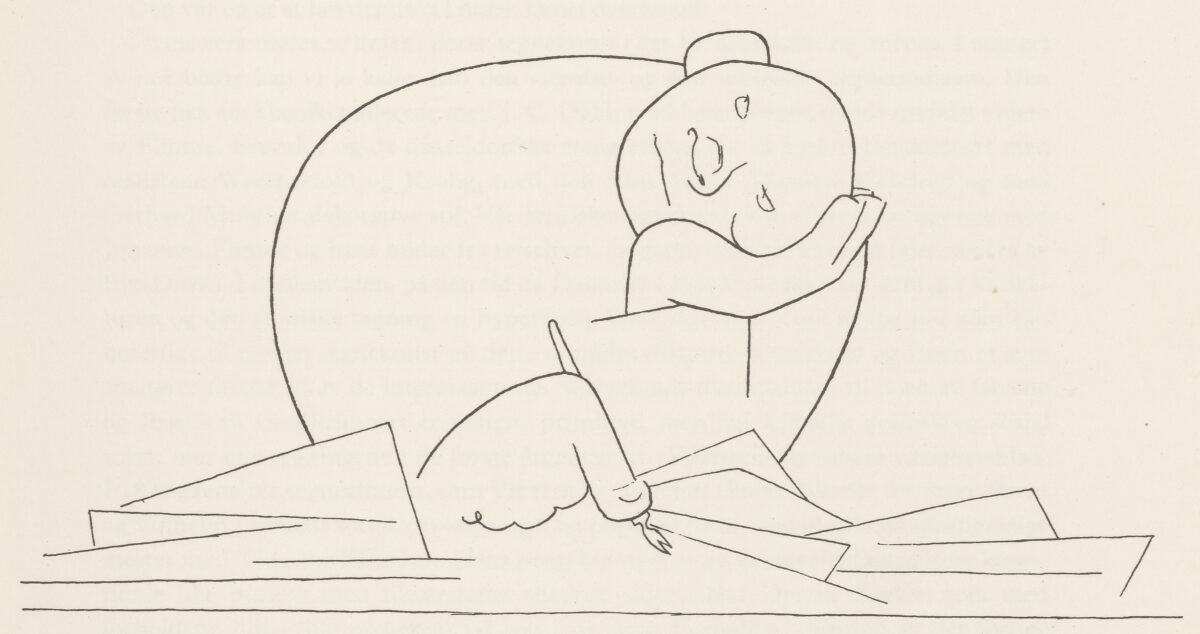
Olaf Gulbransson was one of Norway’s most influential cartoonists. He was a superstar of his day and mingled with some of the most famous voices of the era, such as Bjørnstjerne Bjørnson, Knut Hamsun, and Christian and Oda Krohg.
Already at age twelve, he started attending evening classes at the historical institution Den kongelige Tegneskole (the Norwegian Royal Drawing School), and by the time he graduated, by which time it had been renamed Statens håndverks- og kunstindustriskole (Norwegian National Academy of Craft and Art Industry), his work was already in print in satirical magazines. He received high acclaim for his apt drawings, with his signature style also catching attention outside Norway.
In 1902, Gulbransson moved to Germany to draw for one of Europe’s top satire magazines: Simplicissimus. In the Alpine town of Tegernsee, south of Munich, he built a large house with a studio and swimming pool. Clothes were clearly unimportant to him – for the most part, he wandered around his garden wearing nothing but a drawing apron. During the Second World War, Gulbransson continued working under Nazi censorship, making him a controversial figure in his home country. Despite his contemporary fame, today he is unknown to many Norwegians.
Credits:
Letter from Olaf Gulbransson to Hans Aanrud (undated).
Pictures enclosed with letter to Sigurd Bødtker ((Letter collection: 1873–1958).
Letter from Olaf Gulbransson to Kornrulle Øye (undated).
Letter from Olaf Gulbransson to Ragnhild and Berit (undated).
Letter from Olaf Gulbransson to Sigurd Gulbrandsen, dated
6 February 1948.
Olaf Gulbransson: “Thank-you card with picture of cat” (undated).
Clip from Olaf Gulbransson, short documentary, 1957. Clip from Olaf Gulbransson, short documentary, 1957. Werner Lütje (director, producer), West Germany (Hamburg/Munich), (distributor in Norway: Statens Velferdskontor for Handelsflåten).
Olaf Gulbransson: “Self-portrait” in Det var en gang. Oslo: Dreyers Forlag, 1973.
Ragnvald Blix
(Born in Christiania, now Oslo, in 1882. Died in 1958.)
The prescient cosmopolitan.
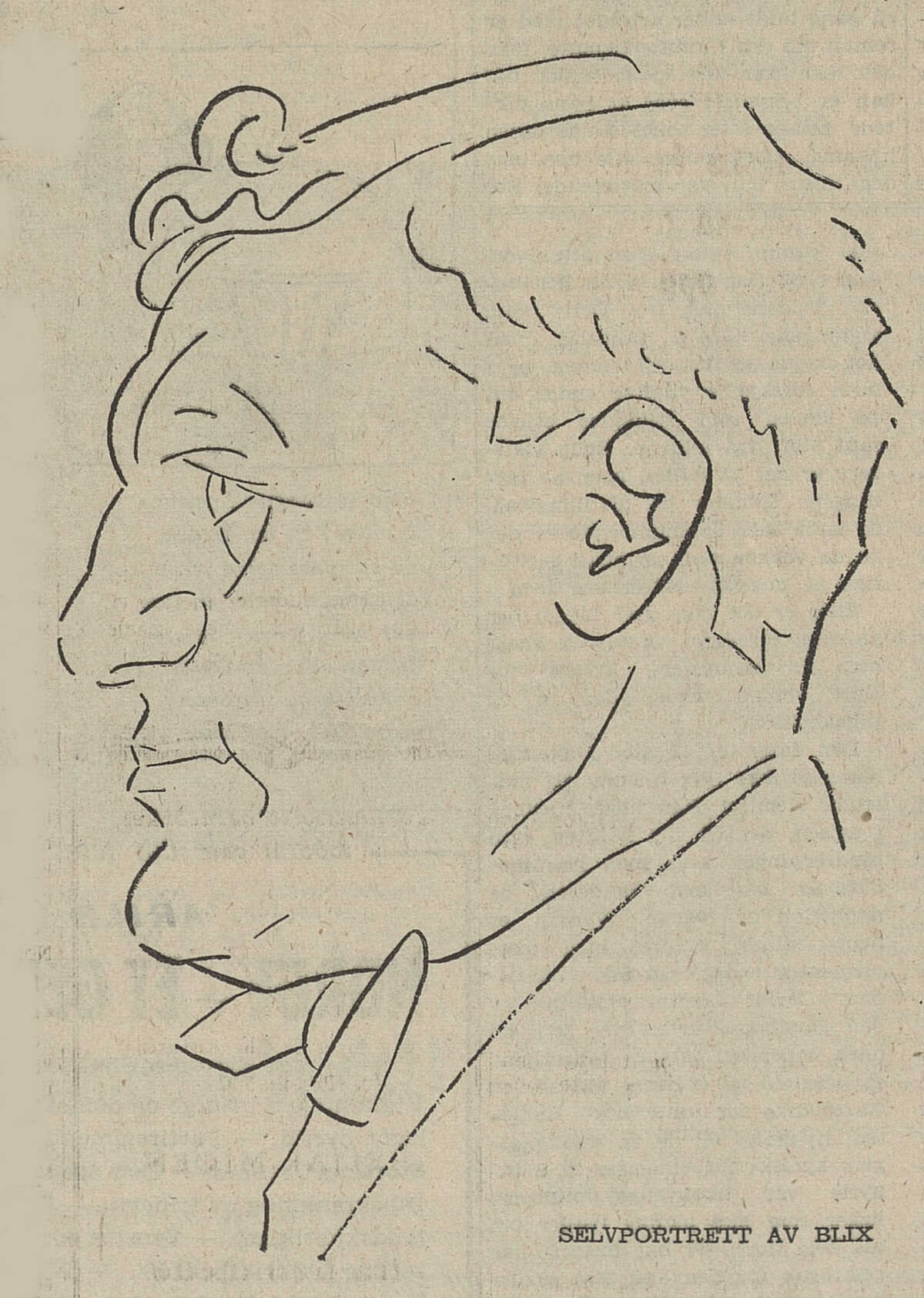
As early as during upper secondary school, Ragnvald Blix began making his mark as a satirist. Together with his friend Einar Skavlan, he started the school newspaper Brage, where they freely satirised teachers and fellow students. His classmate later became chief editor of the national newspaper Dagbladet – a role he held for almost forty years. He described Blix as “an extraordinary discerner and knower of world politics”.
There are many other descriptions of Blix that are more superficial in nature. Most point to his personal charisma and “striking appearance”. His newspaper drawings, however, were crass and stinging. As the son of hymn writer and professor Elias Blix, he came from a bourgeois, intellectual home and was quite comfortable expressing himself in writing as well as drawing. Though he had no formal education, he learned from the best. In 1900, he reached out to his artistic role model Olaf Gulbransson, nine years his senior. This was the first time they would meet, but far from the last. Later, Blix had an apprenticeship with the painter Christian Krohg. With prescience and a precise pen, he greatly influenced people’s understanding of large-scale political matters, in Norway as well as internationally.
Credits:
Top image: Louis Forbech: “Ragnvald Blix”, photo. Christiania (Denmark), approx. 1900. Germanisches Nationalmuseum, German art archive.
Bottom image: Photographer unknown: Portrait of Ragnvald Blix. Kullåkra, Sweden, approx. 1930. Germanisches Nationalmuseum, German art archive.
Ragnvald Blix: “Some recollections: draft” (undated) (for the book Blix – en kavalkade gjennom 50 år, 1952, main editor Sigurd Hoel. Oslo: Dreyers Forlag).
Ragnvald Blix and Einar Skavlan (eds.): “The student union Brage’s newspaper (1897–98)” 17 September 1898.
Ragnvald Blix: “Self-portrait” in Dagbladet, 12 November 1945.
Of course we knew about Stig Höök. When Göteborgs Handels- och Sjöfartstidning was being passed around by hand back in Norway, completely illegally, it was because of Torgny Segerstedt’s articles and Stig Höök’s weekly cartoons. And of course many knew − it was so obvious − that this Höök could be none other than Ragnvald Blix. Those images and sharp-witted points that we knew from before the war, they were inimitable.
Satire’s perpetual dilemmas
We have followed Gulbransson and Blix throughout the years before and during the two world wars. They now lead us into the core discussions of satire: criticism of power, personal cost, boundary lines and how shifting references change the way we read cartoons.
With Gulbransson and Blix as examples, we can use the past to reflect on the present. Many of the challenges faced by satirists today are nothing new. In times of political turmoil and increased polarisation, many of the same issues arise, and cartoonists face difficult choices.
Satire is a balancing act. It is about courage and resistance. It is about freedom of speech and where to draw the line between the challenging and the offensive. It is a question of the cost of free speech – and whether it is something one can live with. It is also a question of how the public receives and understands the satire.